Imagine you are a middle-aged Hartford bank manager in 1900. You have a young family and you want to get out of the smoke and grime of the city in the summer and you seek to protect your children from the dreaded childhood disease of infantile paralysis. Where to go?
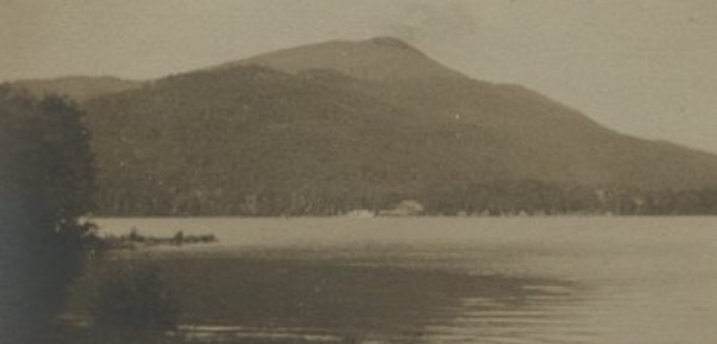
Within a day’s travel, using fast, comfortable steam trains, you have your choice of resorts on the seacoast and in the mountains. Brochures and advertisements tout the virtues of each, and you pore over them by the fire each night. These affordable resort hotels promise both the comforts of home and the novelty of living out in nature. You can drink pure, clean water, eat vegetables grown locally, and savor meat caught or shot nearby. But you can also enjoy the finest wines and cigars afterwards and retire to comfortable beds and clean sheets. One of the most famous of these mountain resorts is Blue Mountain Lake.
Boats were essential elements of resorts on water. There were sturdy rowboats in the hotel liveries for guests to take out themselves, and boats that came with fishing guides. And for the less adventurous guests, any self-respecting resort had excursion steamboats. In northern New York, a fleet of steamboats delighted tourists in the Thousand Islands, some even running the Lachine Rapids.
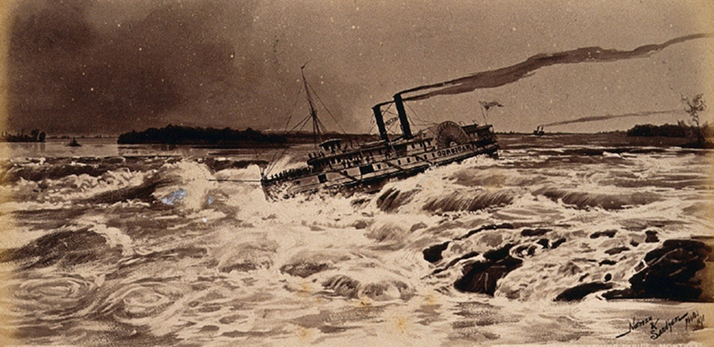
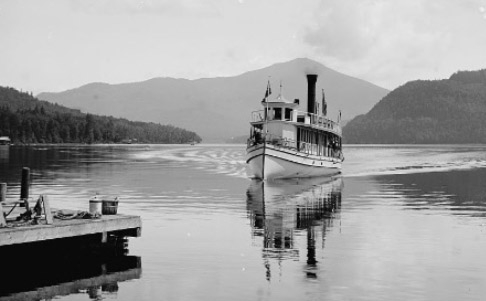
Visitors to the Adirondacks didn’t have the thrills of the big river, but there were plenty of opportunities to enjoy the spectacular mountain scenery from the deck of a steamer. In Lake Placid around the turn of the century, visitors could admire Whiteface Mountain from the water aboard the 73-foot-long Doris. On Schroon Lake, there was Effingham, 68 feet long and the old lady of the region’s fleet, having been built in 1873.
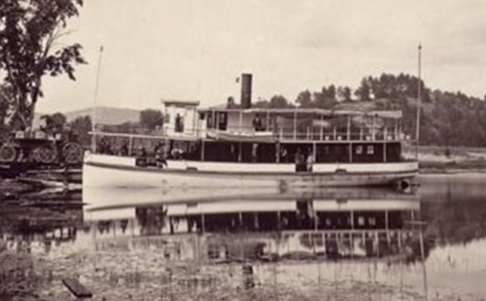
The big excursion steamboats also did duty as transportation between hotels and camps along the waterways. You can see a baggage cart at the dock in the above picture of the Effingham. They could also deliver mail, but their main income, in most cases, was sightseeing. There were typically benches on the upper decks and fore and aft, and more or less cabin accommodation for bad weather.
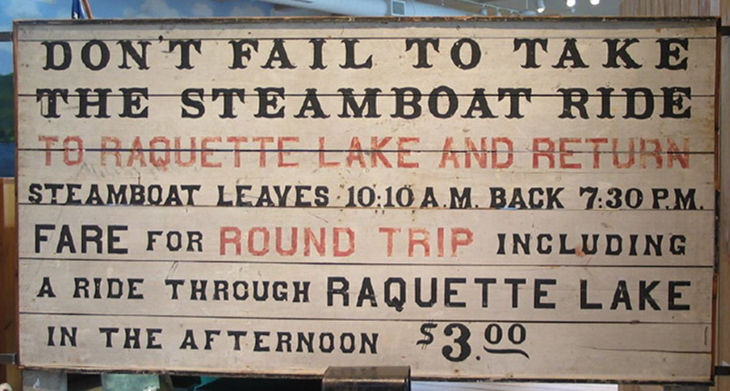
Of course an excursion steamer was part of William West Durant’s scheme for making the Compleat Resort out of the Raquette Lake-Blue Mountain Lake area. He launched the 75-foot Tuscarora on Blue Mountain Lake in 1900, but lost control of all of his businesses that same year. Many of Durant’s schemes faded with his departure, but the popularity of steamboat excursions remained. His transportation network, the steamboats large and small, as well as the Marion River Carry Railroad was taken over by a group of businessmen from Raquette Lake and wealthy camp owners in the neighborhood. The new business was named the Raquette Lake Transportation Company. The company marketed day-long excursions from Raquette Lake to Blue Mountain Lake and return, which afforded the opportunity to “visit two of the most charming bodies of water in the Adirondacks, and the combination of Lake and Mountain scenery is unexcelled anywhere in the North Woods.” Excursionists could purchase a pamphlet that described the scenery, hotels, and camps of the rich and famous along the way. It urged “some of the more strenuous” to climb Blue Mountain, which it says can be accomplished in three hours (and that from the lake!), or the shorter hike to Sunset Point (probably today’s Castle Rock). The view from the latter was admittedly nothing compared to that on the top of Blue Mountain where “it is said that on a clear day twenty-nine bodies of water may be counted.”
Most of the vessels owned by Durant and then the RLT Co were small, in the neighborhood of 20-40 feet, but there were a couple of double-deckers in the fleet, just as in the larger resorts like the Thousand Islands and Lake Placid. In 1902, the company purchased the Adirondack for Raquette Lake, a boat “similar but inferior” to the Tuscarora, according to historian Harold K. Hochschild. HKH loved the Eckford Chain boat’s “contralto” whistle, something “between the soprano tones of the smaller steamboats and the bass of an ocean liner. The sounds of its melodious chord never failed to thrill me,” he remembered.
That whistle still exists, and folks in Blue Mountain Lake can still hear it on summer days from its mount on Steamboat Landing, across the street from where, in the not-too-distant future, the Tuscarora herself will sit.